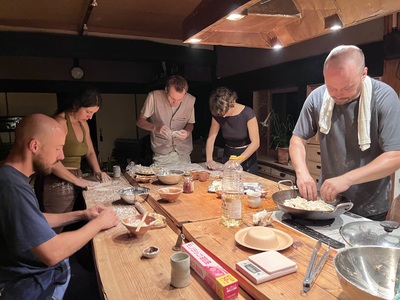
Keep the house of a small school in the Nara mountains 🗾🎌
The experience
We have been building a center for serious study for pottery and Japanese culture, by hand. Our focus now is building the structure and manual; a clear role for people helps us run the house, kitchen, outdoor maintenance.
We hope for: someone who likes supporting a thing and finds the supporting itself worthwhile; someone who is happy to fill their own time with reading, drawing, walking in the forest. We offer nature, safe place, and quiet.
What you offer
25 hours of help per week
Cleaning:
Help clean the kitchen, bedrooms, bathrooms and common areas.
Housekeeping:
Help with changing the bed linens and general housekeeping.
Cooking:
Choose the menu, pick ingredients and cook delicious dishes.
Gardening:
Help grow plants and cultivate gardens
What you get
2 days off per week
Shared Dorm:
You will have a bed in a shared room, which means you will share the same room with other travelers.
Breakfast:
You are entitled to a free breakfast, every day of your stay.
Lunch:
You are entitled to a free lunch, every day of your stay.
Dinner:
You are entitled to a free dinner, every day of your stay.
Use our equipped kitchen:
Feel free to use our kitchen and make your own delicious food.
Fast Internet Access:
High-speed internet for you to work remotely
Requirements
Intermediate English or Intermediate Japanese
Over 25 years old
Welcomes solo volunteers, couples, and partners of volunteers
Academy Course How to become an outstanding Worldpacker
Travel insurance
What's not included
Flights, Travel Insurance, Internal Transportation and Visa
Program Details
We are two potters, married, Japanese and American. Both of us were trained in a lineage; from drawing to ceramic art, and tea & flower arrangements. For five years we have been building a center for serious study, by hand, in a 300-year-old house in a mountain village in Nara. We run programs as we build the facility, so its shape keeps changing. People have come here to study pottery skills and Japanese culture since 2023.
We build mostly from scratch, the studio and kilns included — the annex is going up with timber we re-saw ourselves, and we make the mud walls from the raw materials. We have chosen the slow way, the one that is true to us.
Besides building it by our hand, we have been working with volunteers. In five years more than a hundred people have helped — from the village, a company in Tokyo, and a timber project, from more than twenty countries. Running the center through the care of volunteers is one of the hardest things we have done, and one of the most beautiful.
This November is the beginning of its next stage; we are building the structure for running the house; define a role for people helps us run this. Each role has a manual, written by us, that explains what you are responsible for and how things are done in this house. Part of your week is the work, and part is reading the manual against the work and writing in its margins.
Who we hope for: someone who likes supporting a thing and finds the supporting itself worthwhile; someone who is happy to fill their own time with reading, drawing, walking in the forest. We are surrounded by mountains, rivers, historical sites. There are natural hot springs and craft beer taproom in 5 minutes walk. We offer beautiful space in the house and quiet. You can join Tuesday afternoon community pottery class.
Activities & Shift
The roles:
Each role has a manual. It gives you a clear starting point and something to refer to as you learn, so you can take on the role with confidence. For your week, the role is yours. One person each:
Kitchen steward — the kitchen and the pantry of the center for a week: lunch and dinner for five, the stock of preserves and ferments, whatever is being made that week. For someone who loves cooking, a confident cook with Japanese ingredients.
House steward — how an old house in the mountains is kept through the first cold: the daily cleaning, how the tatami and unfinished wood are cared for, the wood-fired bath laid and lit, knowing which weeds in the garden are medicinal and which are noxious. For someone who loves making a space nice and comfortable.
Outdoor steward — how to protect the old house from the wild: the grass on the slope cut by sickle, the roof gutters (only if the height feels safe to you, and never required). The most physical, for lovers of outdoor work.
The manuals are new; they were drafted at a desk and have never been lived in. Part of your week is the work, and part is reading the manual against the work and writing in its margins — a note, a sketch, a label on a drawer. The next steward reads what you wrote, and keeps improving it.
Meals:
For breakfast — we take turns making Chagayu, rice porridge cooked in tea ( we teach you). Lunch and dinner by the kitchen steward. On the evening you arrive, which we cook, and on your last night, which we cook together.
Wood-fired bath in the evening, a hot-spring public bath five minutes' walk, if you choose.
Rules
Accommodation: One ten-mat tatami room facing the garden, the river audible day and night; the three of you share it, so one gender at a time — women for this time.
Foods: Cooked in one kitchen (we all eat the same) Our cooking uses dashi, a fish stock, in many things, and we cannot run a second menu, so we cannot host a strictly vegetarian, vegan or gluten-free diet.
A house kept by everyone who sleeps in it. Keep the shared space tidy and clean is expected.
Non-smokers only — not people who will step outside.
Cold inside is the normal condition; bring warm layers, including for sleeping.
You get here on your own (Kintetsu Haibara station, then two buses, about 1.5 hours; we send the timetable)
**Weeks we host:**
B — arrive 18 November, leave 24 November;
C — arrive 25 November, leave 1 December.
One week; apply for either or both. Five working days, five hours. Applications for B close 9 November, for C 15 November; we confirm B by 11 and C by 17 November. A week happens only if its three roles are filled.
One thing we want you to know: we are quiet people who think a lot, and being fully with someone takes real energy from us. Because of this, although we work at home, we will not eat every lunch and dinner together; for the same reason, when we sit down together, we are all there. The rest of the time we choose rest, and the living room is yours to be at home in.